So, how do you pick the right Flat Die Pellet Machine? Honestly, it starts with your material—not some glossy brochure. When you're testing in real life, look at moisture, particle size, fiber content, and how much output you actually need. Those things all affect compression, energy use, pellet durability, and how fast the die wears. A machine that runs great on sawdust might struggle with straw or feed mixes. And that difference matters.
Take a close look at motor rating, transmission, die diameter, roller adjustment, and cooling setup. Ask for a sample run with your own material. Then measure hourly production, power draw, pellet length, fines, and operating temperature. Small details tell you a lot. Listen for weird vibration, too. Check if the die and rollers can be swapped without special tools. Clear manuals, easy-to-get spare parts, and tech support that actually answers—these are signs of dependable engineering. And check the supplier's experience through specs, test records, and realistic customer references, not just confident sales talk.
Safety deserves the same attention. Confirm guards, easy access to emergency stops, grounding, overload protection, and electrical docs that fit your region. The best choice isn't always the biggest or the cheapest. It should match your daily workload and your maintenance skills. Leave some capacity headroom, but don't pay for power you'll never use. No machine is perfect. Even a careful buyer can miss hidden wear or inconsistent raw materials. So compare the evidence, inspect the machine in person when you can, and write down your questions before you buy. That kind of disciplined approach leads to more reliable production—and a more honest investment.
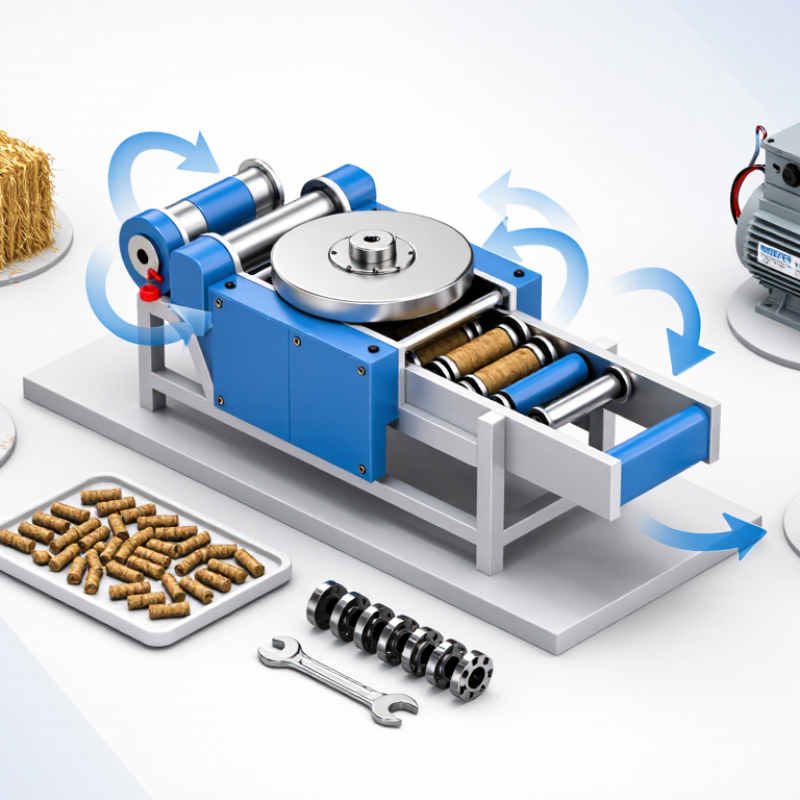
A flat die Pellet Machine is a compact mill that compresses prepared biomass through holes in a rotating or fixed steel die. Rollers apply pressure, while a cutter controls pellet length. Common feedstocks include sawdust, straw, and other clean agricultural residues. In practical operation, feedstock moisture usually needs close control, often around 10–15%, depending on material and die design. Too wet, and the machine may produce soft pellets. Too dry, and energy use can rise.
The machine suits farms, small workshops, and decentralized fuel production because it has a relatively simple structure and lower entry cost than many ring-die systems. However, output depends heavily on material preparation, die thickness, motor power, and operator experience. The IEA Renewables 2023 report projects modern bioenergy growth of 32% from 2022 to 2027, supporting continued interest in pelletizing equipment. ISO 17225-2 also identifies important pellet indicators, including moisture, durability, ash, and bulk density.
Search results may promote a “Hot Sale Biomass Wood Flat Die Pellet Machine”, but sales language is not a performance certificate. I would compare tested capacity, power consumption, spare-part access, and real feedstock trials. A machine rated for dry sawdust may struggle with fibrous straw. That detail is easy to miss. The “best” choice is therefore conditional, and even experienced operators may need several die adjustments before achieving stable pellets.
Choosing the best flat die pellet machine starts with understanding how it works. A motor turns a shaft through a gearbox. The shaft rotates a roller above a perforated flat die. Prepared material enters the space between them and receives pressure.
As the roller moves, it compresses fibers through the die holes. Friction creates heat, but excessive heat can damage sensitive nutrients. Fresh pellets leave the underside and pass through a cutter. Their length depends on the cutter position and material flow.
Moisture matters greatly. Material that is too dry may crumble, while wet material can block the die. Many operators aim for consistent moisture, but the ideal level changes with raw material. In practice, the process is less tidy than diagrams suggest. Small changes matter.
When comparing a China Flat Die Pellet Machine, inspect the die thickness, roller adjustment, motor protection, and cleaning access. A stable frame reduces vibration during continuous operation. Experienced users also check whether spare dies and rollers are easy to obtain. That detail saves downtime.
Before production, remove stones, metal pieces, and oversized fibers. Feed the machine gradually instead of filling the hopper suddenly. Listen for uneven sounds. They may indicate wear, poor alignment, or overload. Regularly inspect die holes and roller surfaces. A machine can appear powerful yet produce weak pellets when compression is poorly adjusted. That is an easy mistake to miss.
How to Choose the Best Flat Die Pellet Machine?
The right flat die pellet machine depends on the raw material, not only the machine’s stated capacity. Common feed materials include ground corn, wheat bran, rice bran, soybean meal, and alfalfa. Biomass options may include sawdust, chopped straw, rice husks, corn stalks, and dry grass. Materials should be clean, reasonably dry, and evenly ground. Stones and metal can damage the die and rollers. Wet sludge is usually unsuitable for ordinary pellet machines.
Different materials create different challenges. Fibrous straw may need smaller particles and steady moisture, often around 10–15%, although the ideal range varies. Oil-rich ingredients can cause slipping inside the die. Rice husks contain silica, which may increase die wear. A small test batch is more useful than a catalogue claim. Check pellet density, surface quality, output, and motor load. This method is not perfect, but it reveals problems early.
Tips: Remove dust, stones, and metal before feeding. Test several moisture levels. Keep simple records. Do not assume one setting suits every harvest. If pellets crumble, adjust the material balance before increasing pressure. A mixed formula may perform better than a single raw material, but the result still needs practical testing.
| Raw Material | Typical Moisture Before Pelleting | Recommended Particle Size | Pelletability | Recommended Pellet Diameter | Pre-Treatment Required | Important Operating Considerations |
|---|---|---|---|---|---|---|
| Sawdust | 10%–15% | 3–5 mm | Excellent | 6–10 mm | Screening and Hammer Milling when particles are oversized | Clean, dry sawdust usually binds well because of its natural lignin content. |
| Wood Chips | 10%–15% | Below 3–5 mm after milling | Good after size reduction | 6–10 mm | Chipping, hammer milling, and moisture adjustment | Large or irregular chips can reduce throughput and increase die and roller load. |
| Wheat Straw | 10%–15% | 3–5 mm | Good | 6–8 mm | Cutting or hammer milling | Long fibers should be shortened to prevent bridging in the feeding area. |
| Rice Straw | 10%–14% | 3–5 mm | Good after preparation | 6–8 mm | Drying, cutting, and hammer milling | Its fibrous structure may require steady feeding and careful moisture control. |
| Corn Stover | 10%–15% | 3–5 mm | Good | 6–10 mm | Chopping and hammer milling | Leaves and stalks can be mixed, but uniform particle size improves pellet quality. |
| Rice Husk | 10%–14% | Below 3 mm | Moderate | 6–8 mm | Fine milling and moisture adjustment | High silica content can increase abrasion; wear-resistant contact parts may be beneficial. |
| Alfalfa | 10%–14% | 3–5 mm | Excellent | 4–8 mm | Drying and chopping if supplied as long forage | It generally pellets easily and is widely used for livestock feed applications. |
| Grass and Hay | 10%–14% | 3–5 mm | Good | 6–8 mm | Drying, chopping, and removal of foreign materials | Excessively dry material may produce weak pellets, while wet material can cause blockages. |
| Corn | 12%–14% | 2–4 mm | Excellent | 2–6 mm | Cleaning and grinding | Suitable for feed pellets; grinding improves uniformity and reduces die pressure variation. |
| Wheat | 12%–14% | 2–4 mm | Excellent | 2–6 mm | Cleaning and grinding | Natural starch can help binding, but excessive fines may affect feeding stability. |
| Wheat Bran | 12%–14% | 2–4 mm | Excellent | 2–6 mm | Screening and blending with other feed ingredients | It is easy to compress but may require a balanced formulation for durable pellets. |
| Peanut Shells | 10%–14% | 3–5 mm | Good after milling | 6–8 mm | Cleaning, drying, and hammer milling | Shell particles can be abrasive; remove stones, metal, and other contaminants before processing. |
| Sunflower Husks | 10%–14% | 3–5 mm | Good | 6–8 mm | Cleaning and size reduction | Lower bulk density may require a controlled and continuous feeding rate. |
| Bagasse | 10%–15% | 3–5 mm | Good after drying | 6–10 mm | Drying, shredding, and hammer milling | High moisture and long fibers can cause poor compression, clogging, or unstable pellet shape. |
Selection note: A flat die pellet machine should be matched to the material’s moisture, fiber content, abrasiveness, required pellet diameter, and expected production rate. The listed values are typical working ranges; actual results depend on raw-material composition, die compression ratio, roller condition, feed rate, and machine power.
Matching a flat die pellet machine to your needs starts with real material demand, not the advertised maximum. Alltech’s 2024 Agri-Food Outlook recorded approximately 1.29 billion metric tons of global feed production in 2023. That figure shows market scale, but it does not define your workshop’s requirement. Record daily demand, operating hours, and seasonal peaks before choosing capacity. A useful calculation is: required hourly output equals daily volume divided by effective production hours. Include a 15% to 25% reserve for moisture changes, die wear, cleaning, and short production delays.
Do not oversize automatically. A machine rated at 300 kilograms per hour may produce less with high-fiber formulas, uneven grinding, or excessive moisture. The Food and Agriculture Organization highlights feed quality, moisture control, and particle consistency as important production factors. Measure actual output. Weigh finished pellets during a timed trial, then compare results with the supplier’s stated capacity. For a small farm producing 1,200 kilograms daily across six effective hours, a stable 250-kilogram-per-hour machine may fit better than a larger unit running below its efficient load. Oversizing also raises motor, electricity, and maintenance costs. My own caution is simple: capacity estimates often look precise, while raw materials rarely behave precisely. Test your hardest formula before final selection.
Match the machine’s practical capacity to your required hourly output, while allowing approximately 25–35% reserve for moisture, formulation, die size, and operating conditions.
Planning benchmarks: required hourly output is calculated from daily pellet demand and available operating hours. Recommended machine capacity includes a practical operating reserve rather than relying on the rated maximum.
Choosing the best flat die pellet machine starts with its motor, not its painted housing.
The International Energy Agency reports that electric motors use about 45% of global electricity. Therefore, motor efficiency affects operating cost every production hour. For small farms, a 7.5–15 kW engine may suit steady batches. Larger lines often need 22–75 kW, depending on throughput, moisture, and material density. Do not select power from capacity claims alone.
Check rated voltage, phase, service factor, and overload protection. A motor should handle short load increases without frequent overheating. The U.S. Department of Energy states that properly matched motor systems can significantly reduce energy losses, especially under variable loads. A practical check is simple: measure running current during real production, not empty running. Empty running can be misleading. I have seen specifications look adequate until wet material enters the chamber.
Die specifications matter just as much. Die diameter, thickness, hole diameter, and compression ratio determine pellet density, output, and motor load. For soft biomass, larger holes may improve flow. Dense materials often require stronger compression and more torque. A thicker die can produce durable pellets, but it may also increase heat and power demand. According to FAO biomass guidance, moisture commonly influences pellet quality and energy use; many feedstocks perform near 10–15% moisture, though the correct range varies. The inconvenient truth is that one die rarely suits every raw material. Test the intended material before purchase, and record output, current, pellet durability, and die temperature.
When comparing a Wholesale Flat Die Pellet Machine, inspect construction before output claims. A rigid steel frame should resist twisting during compression. Check the die plate, roller shaft, and bearing housing for accurate alignment. Even slight misalignment can create uneven pellet lengths, heat, and premature wear. I prefer accessible grease points and removable guards. They make daily checks faster and safer.
The U.S. Department of Energy’s Operations and Maintenance Best Practices guide reports that predictive maintenance can reduce costs by 8–12% compared with preventive maintenance, and by up to 30–40% compared with reactive repairs. Apply that principle here. A machine should support vibration checks, temperature readings, and simple oil inspection. Look for sealed bearings, standard fasteners, and clearly listed replacement parts. Proprietary-looking components worry me.
Maintenance is practical.
During a factory inspection, ask operators to remove the die and roller assembly. Time the task. If two trained workers need an hour, production losses can accumulate quickly. The European Pellet Council’s 2023 market statistics show continued demand for densified biomass, but demand does not excuse poor service design. A clean feed path, firm belt tensioner, and guarded drive system matter. I still underestimate cleaning time sometimes. Dust reaches corners that product brochures never show.
Choosing a High-Quality Flat Die Pellet Machine starts with safety, not output claims. Check for a covered die chamber, stable guards, and an emergency stop within easy reach. ISO 12100 recommends risk reduction through design, guarding, and clear operating information. A machine should also prevent accidental restart after power failure. That small detail matters near rotating rollers.
Dust control deserves close inspection. The U.S. Occupational Safety and Health Administration identifies wood dust as a combustible-dust hazard. IEA Renewables 2023 also forecasts continued growth in modern bioenergy use through 2028. More production can mean more dust exposure. Look for sealed bearings, a practical dust-collection connection, and cleanable surfaces around the feed hopper. Check motor overload protection and temperature monitoring, especially during long runs. A hot gearbox may smell oily before it fails. Do not ignore that warning.
Tips: Ask for noise, vibration, and temperature limits in writing. Test the emergency stop before feeding material. Confirm that guards need tools for removal. Read the manual beside the machine, not later. Keep a log of die wear, lubrication, and unusual sounds. These checks align with ISO 13849 principles for safety-related control systems. Still, a checklist can miss poor training or careless cleaning. Watch one complete operating cycle before approving the equipment.
References: ISO 12100:2010; ISO 13849-1:2023; OSHA Combustible Dust National Emphasis Program; IEA Renewables 2023.
China’s small Feed Pellet Machines are helping farms, workshops, and small enterprises convert locally available biomass into consistent, easy-to-handle pellets. Designed for compact production lines, these machines can process agricultural residues, wood shavings, sawdust, and selected organic materials into either fuel pellets or nutritious animal feed. Their relatively small footprint and practical power requirements make them suitable for home users, small-scale farmers, and sustainability-focused businesses seeking greater control over raw-material utilization.
Industry data highlights the opportunity. The World Bioenergy Association’s *Global Bioenergy Statistics* reports that bioenergy contributes more than half of global renewable energy consumption, while the FAO has identified agricultural residues and forestry by-products as important resources for expanding renewable energy and improving rural value creation. A small pellet mill can support this circular approach by reducing loose-material storage, improving transport efficiency, and turning low-value residues into standardized products. Production results depend on moisture content, particle size, material type, and die configuration, making technical guidance essential.
Reliable Chinese suppliers and factories typically provide equipment options matched to different capacities, raw materials, and pellet diameters. Buyers should evaluate motor efficiency, die durability, safety protection, maintenance access, spare-parts availability, and quality inspection procedures before ordering. With proper drying and preparation, an advanced small pellet mill can deliver stable operation, flexible output, and a practical pathway toward cleaner biomass utilization and decentralized feed production.
A motor turns a shaft through a gearbox. The shaft moves a roller above a perforated die. Prepared material enters the gap. Pressure pushes fibers through the holes. A cutter trims fresh pellets below the die.
Material that is too dry may crumble. Wet material can block the die. Consistent moisture usually helps, but each raw material behaves differently. Small-batch testing is wiser than trusting one fixed number. The process is not perfectly tidy.
Pellet length depends mainly on cutter position and material flow. A closer cutter usually makes shorter pieces. Uneven flow can still create inconsistent lengths. Watch the discharge, not only the adjustment setting.
Inspect die thickness, roller adjustment, motor protection, and cleaning access. A rigid frame reduces vibration. Check whether replacement dies and rollers are easy to obtain. Downtime becomes expensive quickly.
Uneven sounds can signal wear, misalignment, or overload. Weak pellets may indicate poor compression adjustment. Inspect die holes and roller surfaces regularly. A powerful motor does not guarantee strong pellets. That mistake is easy to miss.
Remove stones, metal pieces, and oversized fibers first. Feed gradually instead of filling the hopper suddenly. Sudden feeding can increase load and cause blockage. The machine needs a steady rhythm.
Look for a rigid steel frame, aligned shaft, and accessible grease points. Removable guards make checks faster and safer. Sealed bearings, standard fasteners, and listed spare parts are useful. Proprietary-looking parts make me cautious.
Use vibration checks, temperature readings, and simple oil inspections. Ask trained operators to remove the die and roller assembly. Time the task during inspection. If removal takes an hour, cleaning losses can accumulate. I sometimes underestimate dust. It reaches hidden corners.
Choosing the right Flat Die Pellet Machine starts with understanding how it works. The machine compresses prepared biomass or feed materials through holes in a rotating or fixed die, producing uniform pellets with suitable pressure and moisture control. It can process materials such as sawdust, straw, grass, corn residue, and animal feed ingredients, provided they are clean, properly sized, and adequately dried. Before buying, estimate your required output and select a capacity that matches both current demand and possible future growth without overloading the equipment.
Motor power, die diameter, compression ratio, and die material all influence performance, energy use, and pellet quality. A durable frame, accessible wearing parts, simple lubrication points, and easy cleaning can reduce maintenance time. Buyers should also check safety covers, emergency stop controls, overload protection, stable operation, and clear operating instructions. The best choice is a machine that balances capacity, raw-material compatibility, construction quality, operating safety, and long-term maintenance costs.